My recent posts
I have a script for introductions.
“Hi, my name’s Ethan! I’m a recent graduate looking for opportunities…. Interested in… some fun facts about myself: I love cats and…”
I said all the right things (I hope), but there is still a lingering nervousness, long-lived within me.
It’s been with me since the first week of fifth grade. I just ate my Chobani greek yogurt for lunch. My lips were chap, my throat was gummy and coated with phlegm. We sat in a circle. Today’s icebreaker questions: name, favorite ice cream. My heart was hurting my chest because what if sounded weird?
Disastrously, everyone laughed at whatever the person before me said. Do I wait? Do I interrupt and assert my own introduction with selfish audacity?
Of course when I finally open my mouth, adequately locating the most awkward time to do so, my voice sounds croaky. I feel like a frog. I also forget the questions.
That nervousness is still inside me.
It watches me when I log onto the zoom meeting, before anyone else. When I clear my calendar for a five minute phone call. When I give myself at least two hours for a trip my Transit app says it takes forty-five minutes.
It hugs me when I’m waiting. Waiting to wait. Because I will never be caught unprepared again. Shaky fingers. And I'm so thirsty, but the meeting starts in ten minutes. I don’t have time to get myself a drink.
It is still there, in the obligatory seven dollar coffee for a social-meetup; the incorrect order I drink anyways, so as not to cause a hassle.
I am waiting for it to leave.
Waiting, again.
I’m unsure if this waiting will work.
New introduction. My name is Ethan, that part hasn’t changed. I am a recent graduate, summa cum laude and struggling to find a job.
But I’m not looking for opportunities in underpaid excel formatting and people-pleasing services.
I’m probably not that interested in how China should balance its desire to reshape international rules to reflect its worldview with the need to avoid open confrontation with the United States.
Though, per the nature of my degree, I did learn such things.
I do love cats, still. This is Goyan (pronounced Go-yawn).
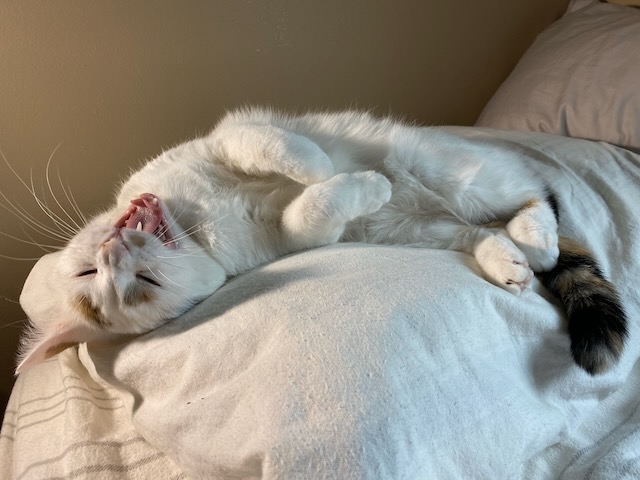
She’s a dumb little thing. The kind of cat that does not land on all-fours.
Her favorite toy is a squirrel: at 3:21am, she’ll yowl loudly with it in her mouth.
She flops on her belly. She waits for me at the door. She loafs on the rug, and crawls in the cat backpack when she wants to go outside.
Far from the greenhouse she started in, Goyan’s becoming a real city-kitty.
But cat-related nonsense can only distract from my introduction for so long. Who, what, when, where, why, how am I?
Who:
Like all people, I am many things. A teamplayer. A leader. A list of all the nouns you might see under the ’qualifications’ section of a job application. Hypocritical (perhaps a person with a changing mind). Confident. Confused. Overwhelmed—usually by movement, loud noises, and too many people talking at once. Sad. Maybe happy. Maybe guilty, for feeling happy.
When people share their first impression of me, it always starts the same.
“You were quiet…” and from there, answers varied. ‘Calm’ is a common one. Sometimes intimidating. But always, I was quiet.
What:
I’m a student—I was. I still feel like one. Is that why we invented the term life-long learner? I’m a boy. Is that important? People ask me where I’m from, or what I am. They mean ‘what kind of non-white are you?’ I’m part Korean, mostly a collage of some northwest European. Wasain, which is apparently quite popular right now. Not long ago, I starting telling people I’m a writer. Not an aspiring writer. An aspiring published author, sure. I stopped mixing who I was with what I liked: “I like to write (in my free time),” because that only helped me avoid confrontation with the truth.
It feels dumb to say “I’m a writer.”
They always reply: “Oh, cool. What sort of things do you write?”
“Well, lots of things,” I say, because I’m not sure how to answer this yet. “But mostly stories. Fiction. Fantasy.”
Then, as my mind tends to imagine: “Oh wow, what a loser living in a make-believe world—get a real job.”
Perhaps I’m self-important. What kind of person needs a stack of paragraphs to introduce themselves? Imagine if there was a line of people behind me. Any genuine curiosity would’ve turned to cringe and frustration by now.
When:
I’m now. I was. I will be. But most importantly, I’m now.
Where:
In consideration of the line behind me, I’ll answer this in terms of a physical location. I’m in D.C., in a studio I share. I could be in Charlottesville, with my family, going to UVA, but I’m not.
Why:
Well, many reasons. My desire to write is one of them.
And how:
‘How’ always messes up the who-what-when-where-why alliteration.
It was the first time I had to confront that fact that complexity cannot be as pretty as the world would like. It was the first time I considered taking a less-than-adequate approach for the sake of simplicity: omit the ‘how,’ as a student might omit a research paper that challenges their thesis.
But I don’t have an 11:59pm deadline. No excuse to avoid an added layer of thought.
How am I?
More specifically: what circumstances led me to this point? Sitting on my bed, eating breakfast, writing on my MacBook, mostly content, only slightly bothered by the fact I start work in three hours.
Systematically, I was born into an educated middle-class family with two loving parents and enough money to support a whimsical childhood and several opportunities to grow. That didn’t hurt. Graduating from a private university also didn’t hurt.
Having my basic needs met didn’t just ‘not hurt,’ it also gave me the foundation to judge what ‘hurt’ was in the first place.
Still, I wonder whether acknowledging the things I take for granted is genuine awareness, passive sympathy, or just a way to ease the guilt of feeling anything less than gratification when there are people out there who have struggled more than me.
Is “checking my privilege” a thoughtful reflection, or just the standard disclaimer to establish credibility as an open-minded person with critical-thinking skills?
Does intentionally subverting the value of your feelings actually make it more appealing? Is saying “I hate working on Mondays,” any different from saying “although I feel fortunate for having a career that pays my rent, buys my groceries, and lets me spoil the people I love, it does kind of suck to wake up at 7am every Monday.”?
Maybe it is different. But who does that difference benefit most? Me, my audience, or the less-fortunate populace whose existence I imply in comparison?
Should I feel guilty for my fortune? Grateful? Neither? Or are we just playing the Great Comparing Game, where I swathe myself in any advantage (or disadvantage) I wanted—so long as I knew the right demographic to compare myself to.
I’m proud of my friend for accomplishing something I couldn’t. I’m envious, too. Why?
The little voice in my head tries to reason around my feelings of inadequacy.
I ask myself: How much of a person is simply the result of the circumstances they were born into? Should their accomplishments be reduced to uncontrollable factors, like luck, opportunity, and parental generosity? Should failures chalk up to a lack of such factors swaying in one’s favor?
Does this kind of thinking erase the agency of a person?
Honestly, I don’t know. And this ramble didn’t bring me any closer to an answer. Maybe the answer lives in the same realm of magical realism. Perhaps it's waiting, behind a “willing suspension of disbelief.”
Or perhaps not everything is a question that needs answering.
I created this site for one reason. It is a place to share my stories. Therefore, my introduction is nothing special: I’m a person who writes.